
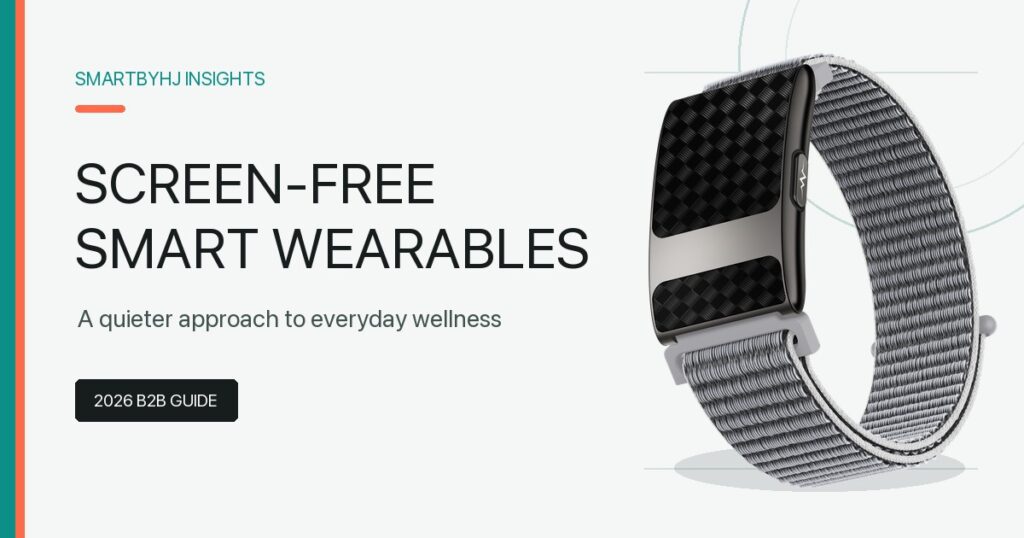
Short answer: A screen-free smart wearable tracks fitness and wellness signals without placing a bright display on the wrist. Data is reviewed in a companion app, while the wearable stays quiet, lightweight and focused on continuous use. For brands, this creates a distinct product category built around comfort, discretion and lower digital distraction.
Updated September 17, 2026.
What Is a Screen-Free Smart Wearable?
A screen-free smart wearable is a connected bracelet or wrist device that collects activity and wellness data but does not use an on-device display as its primary interface. Instead of showing charts, menus and notifications on the wrist, it synchronizes data to a mobile application.
The category includes screen-free fitness bracelets, wellness bands and app-controlled health wearables. Depending on the model, functions may include step counting, sleep tracking, heart-rate trends, blood-oxygen reference readings, temperature trends, sport records, HRV insights and ECG recording features.
Key takeaway: Screen-free does not mean data-free. It means the display and detailed controls move from the wrist to the phone.
Why Are Screen-Free Wearables Gaining Attention?
1. Less distraction during daily wear
A display can be useful, but it also competes for attention. Screen-free devices remove watch faces, menus and bright alerts from the wrist. Users can continue collecting data without repeatedly checking another screen.
2. A more discreet visual language
Without a conventional watch display, the product can look closer to a bracelet or minimalist accessory. This makes the format relevant for comfort-led collections, workplace wellness programs and buyers who want a wearable that does not visually dominate an outfit.
3. Interface decisions become simpler
Product teams can concentrate the detailed experience in the mobile app. The wrist device handles sensing, synchronization and essential feedback, while the app manages charts, settings, firmware updates and historical trends.
4. A differentiated private-label proposition
The smartwatch market is crowded with similar rectangular displays. A screen-free product gives distributors and private-label brands a clearer positioning story: continuous wellness tracking with fewer interruptions.
Screen-Free Wearable vs. Smartwatch
| Consideration | Screen-Free Wearable | Display Smartwatch |
|---|---|---|
| Primary interface | Companion mobile app | On-watch display plus app |
| Daily interaction | Low-touch and background-oriented | Frequent visual interaction |
| Notifications | Usually limited or discreet | Often rich and visible |
| Product appearance | Minimal bracelet-like form | Watch-like form with screen |
| Best suited to | Low-distraction wellness and activity tracking | Users who want controls and information on the wrist |
Neither format is universally better. The right choice depends on the target user, expected interactions and the role the device should play throughout the day.
How Does a Screen-Free Health Bracelet Work?
Most screen-free health bracelets combine motion, optical and other sensors with Bluetooth connectivity. The device collects supported measurements, stores or processes them, and sends the resulting records to a companion app. The app becomes the main dashboard for history, goals and settings.
For example, the TK35Pro screen-free ECG wellness bracelet uses Bluetooth LE 5.3 and the HealthWear app. Its supplied specifications list activity, sleep and wellness-trend functions, IP68 water resistance, magnetic charging and a 180mAh battery. Buyers should confirm final firmware, app behavior and feature availability for their intended market.
Five Design Principles That Matter
Comfort comes before feature count
A product intended for long-duration wear needs a compact body, a comfortable strap and balanced weight. A longer list of features does not compensate for a device that users frequently remove.
The app is part of the product
When there is no screen, onboarding and data interpretation depend heavily on the companion app. Buyers should review pairing steps, language support, chart clarity, data export, account behavior and update processes.
Feedback must be intentional
Vibration, LEDs or other signals should communicate only essential states such as charging, pairing or reminders. Too little feedback can be confusing; too much defeats the low-distraction premise.
Wellness language must remain responsible
Consumer wearables should not be positioned as medical diagnostic tools unless the complete product and claim set has the required evidence and regulatory authorization. Marketing teams should distinguish general wellness trends from clinical measurements.
Battery claims need test conditions
Runtime varies with sensor sampling, Bluetooth synchronization, notifications, temperature and user behavior. Product pages should state that battery-life figures are typical estimates and document the relevant test assumptions.
What Should B2B Buyers Evaluate?
- Hardware: sensor configuration, processor, enclosure, strap, charging method and water-resistance design.
- Firmware: supported functions, update method, stability and power-management logic.
- Mobile app: iOS and Android compatibility, languages, onboarding, permissions and data presentation.
- Customization: logo placement, packaging, strap colors, manuals and app-related options.
- Testing: battery runtime, pairing reliability, wearing comfort and water-resistance validation.
- Compliance: destination-market labeling, privacy, wireless, battery and claim requirements.
- After-sales support: firmware maintenance, defect handling, spare parts and production traceability.
For a broader manufacturing workflow, see our overview of OEM and ODM smart wearables from idea to mass production. Buyers comparing factories can also use our earlier screen-free fitness bracelet sourcing guide as a procurement reference.
Who Is This Product Category For?
Screen-free smart wearables can suit users who want activity and wellness records without a second interactive display. Potential B2B programs include private-label fitness accessories, employee wellness kits, minimalist lifestyle collections, research-oriented wearable projects and promotional programs that require a discreet form factor.
The best market fit is not defined only by age or sport level. It is defined by behavior: the user accepts reviewing details on a phone and values quiet, continuous wear more than immediate on-wrist information.
Frequently Asked Questions
Do screen-free smart wearables work without a phone?
Many models can collect some data while temporarily disconnected, but a compatible phone is normally required for setup, synchronization, detailed history and settings. Storage behavior varies by model.
Can a screen-free wearable receive notifications?
Some models use vibration or simple indicators for selected alerts. Because there is no display, detailed message content is generally reviewed on the phone.
Are screen-free health bracelets medical devices?
Not automatically. Most consumer products are intended for general fitness and wellness reference. Medical claims require appropriate evidence, quality systems and market-specific regulatory authorization.
Does removing the screen improve battery life?
It can reduce display-related power use, but actual runtime still depends on sensors, sampling frequency, Bluetooth activity, battery capacity, firmware and usage patterns.
Can a screen-free wearable be customized for private label?
Customization can include logos, packaging, manuals, strap colors and selected firmware or app options. Availability, minimum order quantity and development scope depend on the project.
Final Takeaway
Screen-free smart wearables offer a practical alternative to notification-heavy smartwatches. Their value comes from a focused combination of comfortable hardware, reliable sensing, a clear mobile app and responsible wellness positioning. For B2B brands, the opportunity is not to remove a screen and stop there; it is to design a calmer product experience from the wrist to the app.
Planning a private-label screen-free wearable? Contact SmartByHJ to discuss samples, customization and production requirements.
Wellness notice: Consumer wearable readings are intended for general fitness and wellness reference unless otherwise validated and authorized. They should not be used to diagnose, treat, cure or prevent disease.
