
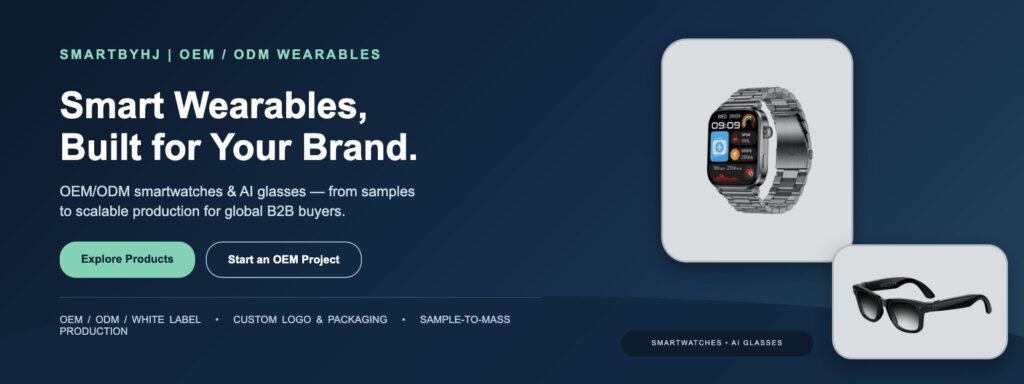
Quick answer: A successful OEM/ODM smart wearable project moves through seven practical stages: define the target market, choose the right product platform, confirm customization scope, build and test samples, lock the specification, control mass production, and prepare export-ready delivery. Buyers reduce delays when they provide a clear product brief, approve measurable quality standards, and keep hardware, firmware, app, packaging, and compliance requirements aligned from the beginning.
For a distributor, retailer, corporate program, or emerging wearable brand, choosing a smartwatch or smart glasses model is only the first step. The real work is turning that model into a consistent, market-ready product that fits a specific customer, price point, sales channel, and launch date.
This guide explains how a typical OEM/ODM smart wearable project develops from an initial idea to mass production, and what B2B buyers should confirm at every stage.
Key Takeaways
- OEM is usually the faster route when a buyer wants to customize a proven wearable platform.
- ODM is better suited to projects that need deeper hardware, firmware, app, or industrial-design changes.
- A clear product brief should define the market, user, sales channel, required features, target quantity, and launch date.
- The golden sample and locked specification should become the reference for mass production and inspection.
- Wellness claims, battery shipping, labeling, and compliance requirements must be checked for the destination market.
OEM vs ODM: What Is the Difference?
OEM usually means adapting an existing product platform with the buyer’s brand, colors, watch faces, packaging, manuals, and other agreed changes. It is often the most efficient route for buyers who want a proven hardware base and a shorter development cycle.
ODM generally involves deeper product development. The project may include changes to industrial design, hardware, firmware, sensors, app functions, accessories, or packaging structure. ODM can create more differentiation, but it normally requires more engineering work, validation, time, and investment.
Many real projects sit between these two definitions. A buyer may begin with an existing smartwatch or smart glasses platform and then add selected custom features. The important point is to define the scope precisely before sampling.
| Decision factor | OEM project | ODM project |
|---|---|---|
| Starting point | Existing product platform | New or substantially modified product |
| Typical customization | Branding, colors, watch faces, packaging, selected firmware options | Industrial design, hardware, firmware, app, tooling, and deeper feature changes |
| Development effort | Lower | Higher |
| Validation needs | Focused on the selected platform and custom elements | Broader engineering and product validation |
| Best suited to | Faster private-label launches | Brands seeking stronger product differentiation |
1. Define the Market and Product Brief
A useful product brief connects the intended user with the commercial plan. Instead of asking only for “a health smartwatch” or “AI glasses,” describe the target customer, sales country, channel, expected order volume, target retail position, and launch schedule.
The brief should also identify must-have features and optional features. For a smartwatch, these may include AMOLED display, Bluetooth calling, activity tracking, wellness functions, SOS, app compatibility, battery-life targets, and strap options. For smart glasses, priorities may include camera resolution, open-ear audio, microphones, translation functions, storage, privacy controls, and wearing comfort.
Clear priorities help the manufacturer recommend a suitable platform without adding cost or complexity that the market does not need.
2. Select the Right Product Platform
Buyers should compare products as complete systems, not as isolated feature lists. The hardware, firmware, mobile app, charging method, accessories, packaging, and support process all affect the final user experience.
Start by reviewing relevant platforms in the SmartByHJ product catalog. For example, a project may begin with an AMOLED smartwatch with Bluetooth calling, a wellness-focused smartwatch platform with ECG and blood-pressure functions, or AI smart glasses with an 8MP camera.
At this stage, request the current specification, supported languages, app information, available colors, accessory options, sample lead time, and indicative production requirements. Confirm which functions are already stable and which requests would require new development.
3. Confirm the Customization Scope
Customization should be documented item by item. A practical scope may cover:
- Logo placement on the device, startup screen, watch face, app, or packaging
- Case, frame, lens, strap, and accessory colors
- Custom watch faces or interface assets
- Language and unit settings for the destination market
- Retail box, insert, label, barcode, manual, and carton marks
- Firmware or app changes that are technically feasible
- Required testing documents and market-specific compliance needs
Every change can affect cost, minimum order quantity, tooling, lead time, or validation. Buyers should ask for these effects in writing before approving development.
4. Build and Evaluate Samples
A sample is not only a visual approval unit. It is the reference for function, materials, comfort, interface behavior, packaging, and quality expectations.
Test the product in the same way the target customer will use it. Pair it with supported Android and iOS devices, review notifications and calls, check charging and battery behavior, wear it for extended periods, and inspect the app experience. For camera glasses, test capture controls, audio, file transfer, storage behavior, and privacy indicators. For smartwatches, review display readability, touch response, straps, wellness data presentation, and connection stability.
Wellness features should be marketed carefully. Unless a specific device and claim have the required regulatory status in the target market, readings should be presented for general wellness reference rather than medical diagnosis.
5. Lock the Golden Sample and Specification
After sample revisions are complete, both sides should approve a final reference, often called a golden sample. The locked specification should record the model, materials, colors, firmware version, app, accessories, artwork, packaging, labels, manuals, test requirements, and approved deviations.
This step protects both buyer and manufacturer. It gives production and quality teams a single standard and prevents late changes from entering the line without review.
6. Plan Quality Control for Mass Production
Quality control should be agreed before production begins. Inspection points can include incoming materials, assembly, appearance, display and touch response, buttons, sensors, microphones, speakers, cameras, Bluetooth or cellular connectivity, charging, battery behavior, firmware version, accessories, packaging, and carton labels.
For a new program, buyers may also agree on pilot production or pre-shipment inspection. The inspection method, sample size, acceptance criteria, and process for handling nonconforming units should be clear in advance.
7. Prepare Packaging, Shipping, and Launch Support
Before shipment, confirm final quantities, carton data, shipping marks, manuals, spare units, accessories, and required documents. Battery-powered electronics may need specific transport documentation and packing arrangements, depending on product and route.
Buyers should also prepare product-page content, images, user guidance, customer-service answers, and warranty procedures before stock arrives. A coordinated launch plan reduces avoidable support problems and helps the first production run generate useful market feedback.
B2B Buyer Checklist
- Target market, customer, price position, and sales channel are defined
- Required features are separated from optional features
- Product platform, app, firmware, and compatibility are confirmed
- Customization items, costs, MOQ, and lead times are documented
- Samples are tested under realistic use conditions
- Golden sample and final specification are approved
- Quality standards and inspection process are agreed
- Packaging, labels, manuals, and shipping documents are ready
- Marketing claims match the product’s intended use and destination-market requirements
Frequently Asked Questions
How long does an OEM smart wearable project take?
The schedule depends on product maturity and customization depth. Logo, watch-face, color, and packaging changes are generally faster than new hardware, firmware, app, or tooling work. A reliable timeline should be based on an approved scope rather than a generic estimate.
What information should I send when requesting a quotation?
Send the target market, selected or reference model, required features, customization list, estimated quantity, packaging needs, certification requirements, destination, and desired launch date. This allows the supplier to provide a more useful quotation and feasibility review.
Can I start with samples before deciding the final order?
Yes. Sample evaluation is an important step for checking product fit and refining the specification. Custom samples may have separate development costs and lead times, especially when they include printed packaging, firmware changes, or new components.
Start an OEM/ODM Wearable Project
SmartByHJ supports B2B buyers developing smartwatches, smart glasses, and wearable accessories for wholesale and private-label programs. To discuss a product idea, send your target market, required functions, expected quantity, customization priorities, and launch timing through the B2B inquiry page.
Our team can then recommend a suitable starting platform and clarify the next steps for sampling, validation, production, and export delivery.
